
A compressed sofa—also known as a "vacuum-compressed sofa-in-a-box" or "boneless couch"—is constructed using high-density, high-resilience PU foam and durable, flexible fabric. It contains no wooden or metal frames and utilizes vacuum compression technology to significantly reduce its packaging volume. Once unpacked, the internal high-resilience foam expands back to its original designed shape and dimensions.
Compressed sofas are typically manufactured through the following step-by-step process:
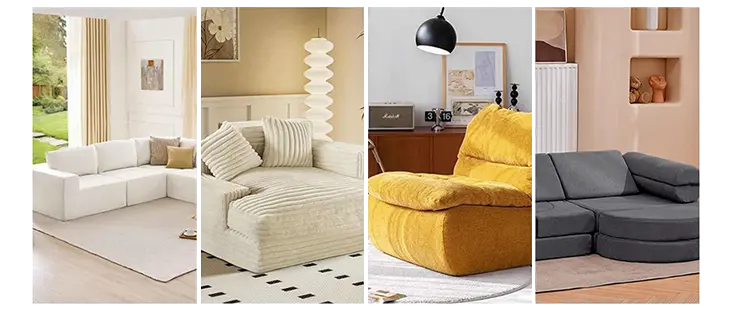
Products mainly made from resilient polyurethane foam are generally suitable for vacuum compression, including frameless sofas, boneless sofas, modular sofas, cloud sofas, foam sofas, bean bag sofas, and foam loungers.
Traditional sofas usually use wooden or metal frames, resulting in larger packaging. Compressed sofas mainly rely on foam structures and flexible materials, allowing the packaging volume to be reduced and transportation and storage efficiency to be improved.
The actual reduction depends on the sofa structure, foam firmness, thickness, and compression method. Compressed sofas can achieve 70–80% volume reduction (1 m³ to 0.2–0.3 m³), but not every product can be compressed to the same ratio.
In many cases, the sofa expands noticeably within a few hours, recovers most of its volume within about 24 to 72 hours, and may require 48–72 hours or longer for more complete recovery. Possible reasons include high foam density or firmness, long compression periods, low temperatures, thick structures, high compression ratios, or insufficient foam resilience.
Yes. Low temperatures can make foam firmer and slow down its recovery, so expansion may take longer in cold environments.
A moderately warm environment can help foam recover, but excessive heat or direct contact with strong heat sources should be avoided to prevent damage to the foam or fabric.
Yes, but whether a sofa can be vacuum-compressed again depends on the foam and product structure. Repeated compression may affect the long-term performance of some materials, so actual testing is recommended.
It may increase the risk of slower recovery or permanent deformation. Therefore, the compression period should be controlled according to the actual performance of the materials (generally should not exceed one year).
Most frameless compressed sofas do not require traditional assembly. They only need to be unpacked and allowed to recover. Modular products may require simple connection or arrangement.
High-density foam generally refers to foam with a higher mass per unit volume. In the furniture industry, "D" is often used to describe foam density. For example, 25D is approximately 25 kg/m³ , 30D is approximately 30 kg/m³ , 35D is approximately 35 kg/m³ , and 40D is approximately 40 kg/m³ .
Density and hardness are two distinct metrics; high-density foam can range from soft or medium-firm to quite firm. High-density foam used for compression sofa seating generally falls within the 60–80D range. The seating feel depends on hardness, compression characteristics, structure, and thickness, rather than density alone.
Higher-density quality foam can generally provide better support, durability, and shape retention, making it suitable for furniture that requires long-term use and compression.
High density mainly describes mass per unit volume, while high resilience describes how effectively the foam recovers after compression.
Higher-density quality foam is often more durable, but durability also depends on the formulation, firmness, resilience, and actual use conditions.
No. Compressed sofas require a balance between support, comfort, resilience, and compressibility.
The appropriate density depends on the design. Different parts may use different densities: 25D–35D for general body; 35D–40D for extra support areas; and 40D+ for high-support structural zones.
Because density is not the same as firmness. Foam can have high density while still being designed to feel soft.
Because compressed sofas remain under pressure during packaging and transportation. Good resilience helps the product recover its size and shape after unpacking.
Possible reasons include insufficient foam density, unsuitable firmness, long-term overloading, weak product design, or poor foam durability.
New PU foam may have a temporary material odor. Proper ventilation usually helps the odor dissipate over time.
Not necessarily. Odor alone is not a reliable indicator of product safety. Compliance should be confirmed based on the actual material and applicable test reports.
Yes. A sofa can combine different foam types for the base, seat, comfort layer, and backrest.
Common fabrics for compressed sofas include corduroy, chenille, velvet, bouclé, faux rabbit fur, and linen. The ideal fabric balances comfort, durability, compression recovery, elasticity, appearance, and cost.
No. A higher fabric weight may imply a thicker, more substantial material, but it can also increase costs, weight, and the difficulty of compression. Thickness affects softness, ease of sewing, the sofa's shape & conformity, compression performance, and packaging volume. A balance must be struck among these factors.
| Fabric | Recommended Weight | Martindale Abrasion | Pilling Resistance | Compression Recovery | Suitability |
| Corduroy | 280–350 GSM | ≥ 30,000 | Grade 4–5 | Excellent | ★★★★★ |
| Chenille | 300–450 GSM | ≥ 30,000 | Grade 4–5 | Excellent | ★★★★★ |
| Bouclé | 350–500 GSM | ≥ 30,000 | Grade 4–5 | Good | ★★★★★ |
| Velvet | 250–350 GSM | ≥ 30,000 | Grade 4–5 | Good | ★★★★★ |
| Faux Rabbit Fur | 400–700 GSM | ≥ 20,000 | Grade 3–4 | Good | ★★★★★ |
Compression itself does not normally cause fading directly, but friction, light exposure, humidity, and fabric quality can affect color performance.
Possible factors include pile direction, lighting angle, surface pressure marks, and the fabric recovery process.
Key quality performance factors include: Foam Density, Foam Resilience, Compression Recovery, Shape Retention, Fabric Durability, Sewing Quality, and Packaging Strength.
A compressed sofa is ready for mass production when its dimensions, comfort, foam recovery, fabric appearance, sewing quality, compression packaging, transportation safety, and production process have all been properly validated.
| Physical Properties | Recommended Specifications |
| Fabric Weight | 350 ± 10% GSM |
| Abrasion Resistance | ≥ 30,000 Martindale cycles |
| Pilling Resistance | Grade 4–5 |
| Colorfastness to Crocking | Dry ≥ 4 / Wet ≥ 3–4 |
| Colorfastness to Washing | Grade 4–5 |
| Colorfastness to Light | Grade 3–4 |
| Tensile / Tear / Seam Slippage | Pass |
| Compression & Wrinkle Recovery | Good to Excellent |
| Dimensional Stability | Shrinkage ≤ 3% |
| Physical Properties | Recommended Specifications |
| Fabric Weight | 300 ± 10% GSM |
| Abrasion Resistance | ≥ 30,000 Martindale cycles |
| Pilling Resistance | Grade 4–5 |
| Colorfastness to Crocking | Dry ≥ 4 / Wet ≥ 3–4 |
| Colorfastness to Washing | Grade 4–5 |
| Colorfastness to Light | Grade 3–4 |
| Tensile / Tear / Seam Slippage | Pass |
| Compression & Wrinkle Recovery | Good to Excellent |
| Dimensional Stability | Shrinkage ≤ 3% |
Faux rabbit fur is a plush synthetic pile fabric designed to replicate the ultra-soft touch and high-end aesthetic of natural fur (recommended weight: 400–500 GSM).
| Physical Properties | Recommended Specifications |
| Fabric Weight | 400–500 GSM |
| Abrasion Resistance | ≥ 20,000 Martindale cycles |
| Pilling Resistance | Grade 4–5 |
| Colorfastness to Crocking | Dry ≥ 4 / Wet ≥ 3–4 |
| Colorfastness to Washing | Grade 4–5 |
| Colorfastness to Light | Grade 3–4 |
| Tensile / Tear / Seam Slippage | Pass |
| Compression & Wrinkle Recovery | Good |
KINGSEN is dedicated to providing superior service.
Welcome tocontact us with any questions or inquiries.


